
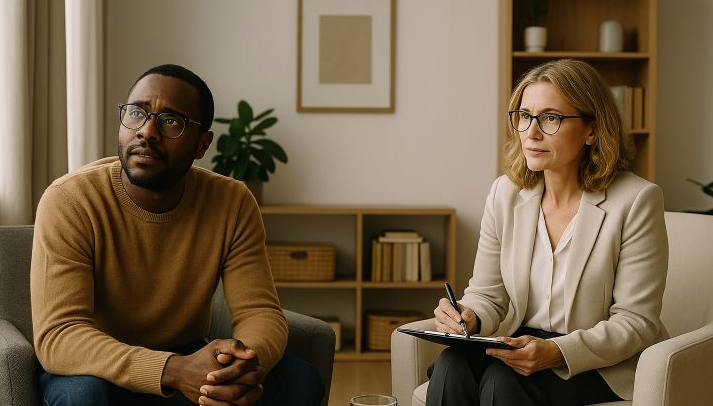
Your past care may be spread across old patient portals, appointment messages, paperwork, and personal memories. One record may list a medication you no longer take, while another may contain a date or description you do not recognize. The goal is not to produce a perfect medical autobiography. Instead, create a concise background summary that identifies what you know, where the information came from, and what remains unclear.
The National Institutes of Health (NIH) appointment preparation guidance recommends organizing medical and family history and information about other healthcare providers. The National Institute of Mental Health (NIMH) also recommends preparing questions and a list of all medications, including over-the-counter products and supplements. These steps can be particularly useful when preparing for a first psychiatry appointment. The following workflow offers an optional organizational method, not a validated clinical instrument or required intake form.
1. Define a Small Output Before Collecting More Material
Create a working medical history map, followed by a concise summary based on that information. Keep supporting records separate. The map can be detailed and longer, while the summary should help a psychiatrist distinguish current information from previous care without searching through every attachment. Begin with the records you already have rather than waiting for every former healthcare provider to respond.
Organize the summary into three sections: “Current information, as of 2026,” “Earlier care and health history,” and “Unanswered questions or conflicting information.” Each section serves a different purpose. The first provides a current snapshot, the second establishes a timeline, and the third prevents uncertain details from being presented as facts simply because they appear in an organized document.
2. Gather Available Pieces and Record Their Origin
Review records already in your possession, personal notes, healthcare provider names, appointment dates, and your current medication list or packaging. Identify where each detail originated, such as a dated visit summary, patient portal entry, medication label, or personal recollection. NIH’s healthcare communication guidance highlights access to medical records as a way to track diagnoses, treatment plans, test results, and medications.
Create a brief locator list for supporting documents, including the document name, approximate treatment period, and where the information can be found. You do not need to copy entire reports into the summary. If information is unavailable, note that limitation. Requesting additional records is a separate task. You can ask the relevant office how to obtain copies without making complete record collection a requirement before seeking professional help.
3. Build the Current-Information Section Separately
Date this section and list the medical conditions and healthcare professionals you know are involved in your current care. Include questions about anything you cannot confidently describe. Maintain a separate list of current medications and supplements, including nonprescription products, as NIMH recommends. Record information you know rather than guessing medication names, dosages, or reasons for use.
Do not include an old prescription in your current medication list simply because it appears in a patient portal. If an older document conflicts with your recollection, preserve the discrepancy as a question for your clinician or pharmacist. This organizational exercise is not medication reconciliation and cannot determine which prescription instructions are correct. Do not start, stop, or change treatment to make your paperwork consistent.
4. Place Earlier Care on an Approximate Timeline
For each previous treatment period, use consistent categories: approximate date or life stage; clinician or service, if known; what happened; what you remember about the experience; and the source or uncertainty. Include previous mental health care and relevant medical history you want help explaining. A date range or description such as “around the time I moved” is preferable to an exact date you cannot verify.
Use straightforward language when describing remembered treatment responses, such as “I remember sleeping better for a while” or “I do not remember whether it helped.” Keep personal recollections separate from documented information. If a record identifies a diagnosis, describe it as the terminology used in that dated document rather than presenting it as your current diagnosis. Leave clinical interpretation and treatment decisions to the appropriate healthcare professional.
5. Mark Documented, Recalled, and Uncertain Details
Use “Documented” for information supported by a specific record, “Recalled” for personal memories, and “Uncertain” for missing or conflicting details. Documented information means that a record contains a particular statement; it does not establish that the information remains current or resolves a clinical question. A single entry may contain more than one classification.
For example, an invented history-map entry might read: “Around 2020–2021; counseling at a former clinic; Recalled: attended for several months; Documented: an appointment message dated March 2021; Uncertain: start date and treatment approach.” The message confirms the documented appointment date, not the entire treatment period recalled from memory. This is a formatting example, not an actual patient history.
When two sources conflict, preserve their dates and descriptions side by side in your working map. In the summary, condense the discrepancy into a question: “Two records provide different dates for this treatment, and I am unsure which is correct.” Do not combine potentially separate events or select a diagnosis merely to eliminate an inconvenient contradiction.
6. Add Brief Context Without Collecting Everyone’s Private Story
If you already know relevant family health information, include a brief note while clearly identifying any uncertainty. “A relative reportedly received treatment; details unknown” differs from a confirmed diagnosis. You do not need to contact relatives or obtain their medical records to complete your summary. Exclude unnecessary names and identifying information.
Store personal copies in a location you control. Before sharing documents, ask the receiving office which communication channel it uses and what information would be useful. Verify the recipient and avoid placing sensitive medical history in broadly shared documents. A convenient application, email address, or cloud link does not automatically guarantee privacy.
7. Compress the Map Into a Usable Background Summary
Review your working map and prepare a shorter version containing a dated current-information section, several important previous treatment milestones, and a few unresolved questions. Preserve source labels when condensing information. Keep duplicate paperwork and detailed supporting records in the locator list rather than repeating their contents. The objective is a readable background summary, not an independent determination of which information establishes a diagnosis.
Conclude with a statement such as, “This summary combines available records and my recollections; dates and details marked uncertain require clarification.” Bring or share the information you have and explain any gaps. Do not postpone seeking care until your timeline is complete. Update the summary when details are clarified while continuing to identify earlier information as historical.
This article provides general educational guidance for organizing medical information. It is not a diagnostic tool, a medical records requirement, or an instruction to change treatment.
Sources
NIMH — Tips for Talking With a Health Care Provider About Your Mental Health
NIH — How To Prepare for a Doctor’s Appointment
NIH — Talking With Your Doctor or Health Care Provider
Strict reminder from Brain Health USA to seek a doctor’s advice in addition to using this app and before making any medical decisions.
Read our previous blog post here: https://brainhealthusa.com/report-psychiatric-medication-side-effects/